


Innovation is not a single abstract industry theme. The same market shift looks different depending on where you sit. This was a big takeaway from the discussions and conversations at the inaugural Mobile Network Innovation Summit (MNIS).
For operators, the question is how to modernise without losing focus. For vendors, it is how to remain central as the network becomes more software-defined and open to new players. For founders, it’s how to turn promising technology into something an operator can actually adopt. For investors, how to identify which parts of telecom are becoming more dynamic, more accessible and more commercially viable.
This matters because telecom innovation is no longer just about the next radio cycle. It’s about AI-enabled operations, non-terrestrial access, energy architecture, trust and security, software control, and the ability to commercialise all of that more effectively than before. The implications are not uniform. Different audiences need to act differently.
For operator CEOs, innovation has to become operating discipline
The strongest message for operators’ chief executives is that innovation can no longer live comfortably as a narrative while the organisation itself remains built for caution.
One of the clearest themes at MNIS was that too many operators, particularly in Europe, have become structurally conservative. They are constrained by short-term shareholder expectations, fragmented priorities, and an understandable but damaging reluctance to make the focused bets that create meaningful network advantage. The result is not a lack of technical ambition in the industry. It is a lack of organisational follow-through.

That does not mean operators need to become reckless. In fact, the message from the summit was almost the opposite. What is required is not indiscriminate spending, but disciplined boldness. The operators most likely to benefit from the next phase of network innovation will be the ones that choose a small number of strategic priorities, align the business around them, and create a credible path from invention to deployment.
That shifts the CEO’s role. It is no longer enough to sponsor innovation rhetorically or to support a handful of visible pilot programs. The real executive task is to remove internal friction, align incentives, create clearer sponsorship across functions, and make sure innovation has backing well beyond a central innovation team.
The practical implication is simple: operators should treat innovation as a portfolio of strategic capabilities, not a collection of experiments. AI-enabled operations, resilient multi-domain access, energy-efficient architecture, secure transition planning and ecosystem commercial models should each have an executive owner, a business case and a route into mainstream planning.
For CTOs and network leaders, the future network is converged and trust-critical
For technical leaders, MNIS pointed to a future in which network planning can no longer be done one domain at a time.
The strongest operator contributions described a network that is service-aware, self-optimized, secure and increasingly converged across fixed, mobile and non-terrestrial access. That is a major shift in emphasis. It means the future network is not simply a better radio network. It is a broader control environment in which connectivity, policy, software, security, observability, orchestration and energy design are all interdependent.

In practical terms, this means CTOs need to think in terms of control planes and operating systems, not just spectrum, radios and site assets. NTN is not just a coverage issue; it is also a question of service continuity and customer experience. AI is not just a tool layered on top of operations; it affects data quality, workflow design and how decisions get made. Energy is not just an efficiency target; it is an architectural variable. Quantum is not just a future security concern; it belongs in long-term trust and transport planning now.
This significantly broadens the technical remit. Future network leadership will increasingly be judged by the ability to integrate disciplines that were once treated separately: networking, software, cyber, AI, energy and service design.
That, in turn, makes technical simplification even more valuable. The more fragmented and over-complex the network becomes, the harder it is to insert intelligence, optimize energy use or manage future security transitions safely.
For CFOs and strategy leads, the case for innovation must be framed differently
Another important theme from the summit was that network innovation often struggles for board-level support because it is framed too narrowly.
Too often, innovation is presented as technical improvement rather than economic leverage. But what emerged from MNIS was a broader and more useful investment lens. Innovation in telecom creates value in several different ways: by reducing opex through automation and more efficient infrastructure, by improving capex productivity through better architectures and deployment methods, by expanding addressable market or service continuity through NTN and better coverage models, and by reducing strategic risk through stronger security and future-readiness.

This matters because not every innovation needs to produce immediate revenue to be worthwhile. Some of the most important investments will be justified because they lower future cost exposure, improve the economics of traffic growth, increase resilience, or preserve relevance in a changing market.
That is a more sophisticated framing than the simplistic question of whether a technology directly monetises. CFOs and strategy teams should increasingly ask whether a proposed innovation improves the economics of the operator over time, not just whether it launches a new product next quarter.
In that sense, the summit’s treatment of AI, energy, NTN and quantum all pointed in the same direction: telecom needs a broader model for valuing innovation.
For major vendors, the opportunity is to become the platform for ecosystem absorption
The summit also carried a clear message for large vendors.
On one hand, vendors remain central. Operators still need scale, support, operational trust and long lifecycle management, especially in high-substitution-risk parts of the infrastructure stack. The summit did not suggest that incumbents are about to disappear.
On the other hand, it also made clear that operator dependence on incumbent suppliers has become part of the innovation challenge. When operators feel that vendors slow down the adoption of new capabilities, act as bottlenecks to integration or defend installed base at the expense of ecosystem progress, frustration builds quickly.
That creates both risk and opportunity.

The risk is obvious: vendors are seen as obstacles. The opportunity is more interesting: vendors can position themselves as the fastest and safest way for operators to absorb new capabilities. In a world shaped by AI-native operations, NTN convergence, energy redesign and quantum-safe transition, the vendor that best enables controlled openness could actually deepen its relevance.
That means vendor strategy increasingly needs to include ecosystem design. Which third parties can plug in? Which APIs, partner models and operating approaches make adoption easier? How can external innovation be integrated without undermining lifecycle assurance or network reliability?
The companies that answer those questions well may gain more than those that simply focus on product depth alone.
For founders, insertion logic matters more than brilliance
For startup founders, MNIS was both encouraging and sobering.
It was encouraging because the summit showed that operators are actively looking for help in areas where startups and scale-ups can genuinely add value: software, intelligence, automation, energy, indoor economics, security and new service integration. It was sobering because it also made clear that telecom is not a neutral market in which the best technology automatically wins.
Success depends heavily on insertion logic.
That means founders need to know exactly where they fit in the value chain, which internal operator sponsor benefits from their proposition, how they relate to incumbent vendors, and how success will be measured. If they cannot answer those questions clearly, their chances diminish quickly, no matter how strong the underlying technology may be.
The summit also suggested that founders should be highly selective about which parts of telecom they target. The deeper infrastructure layers remain difficult for new entrants because substitution risk is high and buyers are cautious. By contrast, software, intelligence, operations, security, integration and efficiency layers are more open. They are not easy, but they are more strategically plausible.
Perhaps the most practical lesson is this: founders should not sell “innovation” in the abstract. They should connect technical novelty to a visible operator pain point, a real deployment path and a measurable commercial outcome. The more concrete that line of sight becomes, the more credible the company becomes.
For investors, telecom is becoming more granular and more investable
Finally, the summit carried an important implication for investors.
Telecom has often felt unattractive because it is discussed as one monolithic sector: slow, regulated, procurement-heavy and difficult to penetrate. MNIS suggested a different way to think about it. The opportunity is becoming more granular.
That matters because granular markets are easier to underwrite than abstract ones. A company improving indoor neutral-host economics is not the same kind of investment as a company tackling quantum-safe transition. An AI-driven network planning platform is not the same as an NTN integration business. Each sits in a different layer of the stack, with a different buyer, a different budget owner, a different risk profile and a different path to scale.
That is actually good news for investors. It means telecom is becoming more legible.

The more useful investment questions now are not “is telecom attractive?” in the abstract, but rather: where in the operator stack is budget pressure rising? Where is openness to new suppliers increasing? Where can a company show value without requiring full network replacement? Where do software and service models create leverage over hard infrastructure constraints?
Those are the parts of telecom that are becoming more investable.
The bigger point
What MNIS 2026 made clear is that telecom innovation is no longer a single conversation. It is a set of different decisions for different players, all happening at once.
For CEOs, it is about moving from narrative to operating discipline. For CTOs, it is about managing a more converged and software-defined network environment. For CFOs, it is about valuing innovation more strategically. For vendors, it is about becoming better ecosystem enablers. For founders, it is about adoption logic. For investors, it is about understanding telecom in layers rather than as a monolith.
That may be the clearest sign that the market is changing.
The future of telecom innovation will not be shaped only by who has the best technology. It will be shaped by who best understands their role in turning that technology into adoption, scale and value.
That is where the next competitive advantage is likely to emerge.
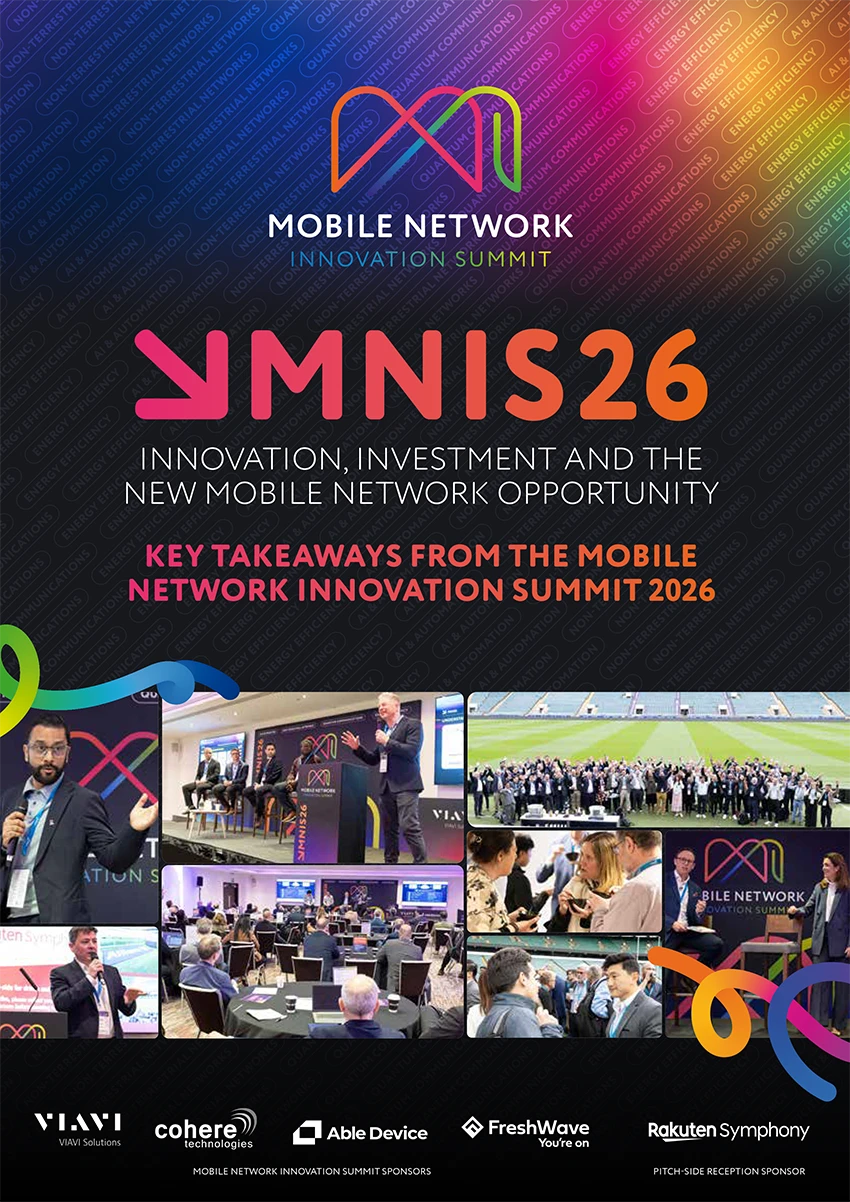
Download the full KEY TAKEAWAYS FROM THE MOBILE NETWORK INNOVATION SUMMIT 2026 here.